Wednesday, October 09, 2013

Our Tobacco Control Appeal to the Hon. Minister of Health


Since the current administration began in 2011, there has been a deliberate effort at presenting a scorecard of its work come May every year. This year was no exception as each minister in the federal cabinet made presentations on the work over the past year and its impact on the lives of Nigerians.


The Hon. Minister of Health, Prof. Onyebuchi Chukwu made his presentation on June 13, 2013 as part of the 2013 Ministerial Platform to showcase the mid-term achievements of the current GEJ administration in the health sector. One of this is the eradication of guinea worm in Nigeria for which the World Health Organisation (WHO) issued Nigeria a certificate to be presented later in 2013.

However, while we celebrate this, we wish to call attention to an issue we believe needs to be treated with greater urgency as we seek to protect the health of Nigerians without discrimination. This is none other than the enactment of a Tobacco Control Bill in Nigeria.

In July 2012, Mr. President delegated to a team of ministers led by the Hon. Minister of Health, the task of drafting a new executive bill on Tobacco Control for proper legislation. This was after the efforts pre-2011 has failed to get Presidential approval for the bill passed by both chambers of the legislative arm of government in that session.

On June 14, 2013, while making his presentation at the 2013 Ministerial Platform, the Hon. Minister of Health was widely quoted as saying 'smoking will soon be banned in Nigeria as the Federal Government could no longer condone smoking.'

On Saturday 20th  July 2013, President Jonathan speaking in Abuja said that a revised anti-tobacco bill that provides tougher control on use is ready for legislative action. According to him, the Attorney General of the Federation has concluded work on the bill, while the Federal Executive Council would soon give a final approval for onward presentation to the National Assembly. He also gave the assurance of ample political will to ensure the bill becomes law.

These statements were widely reported in the media without any rebuttals from the Presidency nor the Hon. Minister of Health, Prof. Onyebuchi Chukwu.

It is therefore of great concern that in spite of all these words, the team assigned by the President to draft a new bill on Tobacco Control (aka Anti-Tobacco) Bill and led by the Hon. Minister of Health is yet to submit its work to the President & the Federal Executive Council (FEC) for deliberations and onward passage to the National Assembly by the President.

While it is true work has been concluded on drafting the bill, failure to present such before FEC to deliberate and approve for onward passage to the National Assembly has become a critical cog in the wheel of making the draft bill into law.

Knowing this is the first step with others following as outlined in our legislative process, we are therefore appealing to the Hon. Minister for Health to finish the task assigned to his team by leading the charge in ensuring the draft bill is presentation before FEC without delay and approved so it can move onto consideration by the Senate & House of Representatives. This is our CLARION CALL!


To join us in making this strong appeal to the Hon. Minister of Health, add your voice by visiting his facebook page, like our post, drop your comments and share widely with others. Lets help make Nigeria a SMOKE-FREE zone TODAY

Wednesday, October 02, 2013

Quit Making Excuses & Stop NOW!


I don't know about you but I dare anyone to say s/he has never tried to rationalize things before.  Infact, one might find oneself rationalizing once a hard decision is to be taken almost every time. When it comes to our lifestyle, rationalizing a bad habit is human nature, especially if it is a habit that has been done for quite a while.

Smoking is not different as many people toy with the idea of quitting smoking, only to settle back into old habits at the sign of stress or simply as a fear of change.  For those who struggle tremendously with quitting smoking, the belief that "some people just can't quit" resonates with their broken confidence in their ability to quit. 

The biology of addiction & withdrawal as well as psychological dynamics of smoking scheme to undermine the smokers' self-confidence, which is a central component of long-term quitting success.

While changing smoking status can be hard,no excuse is good enough not to stop. It is important therefore, to know & understand some of the most common excuses you might be using to delay stopping and/or justify your smoking habit.

...............................................................................................................................................
 
1) The damage is done
Some people practice self-deceit claiming that they are so far gone that there is virtually no reason for them to even try to quit. This is a self-defeating and self-fulfilling prophesy as researchers have confirmed that 48 hours after your last cigarette, the body will begin to heal.

This means that as soon as a person quits, the body begins to repair itself with marked improvements seen in breathing and sense of taste and smell just a few days after stopping. By quitting, we will also be improving the health of our family and friends by not exposing them to passive smoking or second hand smoking.

2) I'll gain weight
Some folks think they need to smoke to control their weight and if they stop, their body weight will balloon. This common misconception is a very dangerous trend that should be nipped in the bud. According to the experts, nicotine does not stop you from becoming hungry instead the habit might reduce the opportunity for one to eat. Anyway, undertaking some regular exercise or eating low-fat food options is much more beneficial for weight control

3) I'll get stressed
It is amazing how many people once stressed, resort to a puff. Despite what you may think, nicotine doesn't calm you down as nicotine cravings between cigarette sessions make you feel stressed and anxious. Quitting the habit ensures these cravings over time reduce and is eliminated.

4) Quitting will ruin my social life
For many people, cigarettes are an important part of their social life with some of us only having a cigarette when with friends who smoke or during nights out. You may also have bonded with colleagues during cigarette breaks.

However, cigarettes are not the ultimate party trick as there is a lot more to explore around us helping us to expand our horizons. It's a good idea to give up friends who are impatient with you for giving up the cigarette.

5) Smoking looks good
For some people, holding a stick of tobacco wrapped in paper seems attractive and fashionable. Teenagers may think it makes them look older or cooler but many people find the sight of a smoker unattractive. Yellow fingernails, blackened fingers and a stained tongue are not a pretty sight.

Smoking also makes your complexion dull and prematurely ages your skin. So if you don't want to look old before your time, it's a good idea to quit. Also, cigarette smoke sticks to our bodies long after having the last cigarette of the day. Some people think kissing a smoker is like 'kissing an ashtray'. If you'd prefer to smell fresher, now's the time to quit.

...............................................................................................................................................
There is some truth in smoking is an addiction that's undeniably tough to quit but it's not impossible. However, to quit requires a lot of determination, so when you catch yourself making any of these excuses or inventing new ones, think again and reconsider for your health depends on it!


To spread the 'No Tobacco' gospel, join the campaign for Tobacco Control legislation in Nigeria by signing up as a Cause Champion. Simply send your 1) Name, 2) Email address, 3) Telephone No and 4) Location to info(at)socialresponsibilitymanagers.org. Signing up will get you a chance to have a specially designed Facebook, Twitter and G+ profile banner graced with Stella Damasus' and Fela Durotoye's pictures.

You should also actively participate in the discussions presently ongoing on the following social media platforms:
- Twitter: Follow @TobaccoCtrl
- Facebook: Visit and like Tobaccoctrl
- Google Plus: add Tobaccoctrl to your circle
- 2go: add Tobaccoctrl

Wednesday, September 25, 2013

Becoming an Ex-Smoker


Ask anyone who smokes whether a teen smoker or a lifetime pack–a–day smoker, quitting can be tough. Infact, it seems quite a number of people get on the bus then hop off long before they get to their destination. Yet, with the right game plan tailored to your needs, you can break the addiction, manage your cravings, and join the millions of people who have kicked the habit for good and hold the status 'I AM AN EX-SMOKER'.

To smoke or not to smoke is a lifestyle decision that significant effects for the person and others people around the smoker. While there exists a vast array of resources (online & offline) with varying claims of success when it comes to helping a person become a non-smoker, the first step in this journey is Why?
It is true smoking has harmful effects and various people decide to stop smoking for diverse reasons. 

However it is critical that having made up one's mind to stop smoking, this journey starts by answering the question 'why do I smoke in the first place?'. This is because since smoking is a habit that has gone on for some time, to stop requires one being motivated by a powerful, personal reason to quit. This could range from wanting to protect friends & family from second-hand smoke (shs) effects, desiring younger-looking appearance,  no smoking policy in your new office amongst others.

The truth is no two people stop smoking for the same reasons owing to our personalities and circumstances but every smoker requires appropriate motivation to change status. Answering the why question and other follow-up questions will greatly aid one's ability to stay the course while embarking on the journey.

After outlining our answers, the next step is to choose a specific quit date e.g. I will quit starting from Oct 1. For some folks, they try to quit smoking each year on their birthday or make 'I will stop smoking this year' another New Year's Resolution that more often than not bites the dust. Choosing a quit date has been shown to greatly increase the odds of achieving set objectives as it makes it more likely that you’ll succeed.

However, so as not to lose motivation to quit, it is recommended that the quit date chosen be within 2 weeks though, so one will have enough time to prepare. If you mainly smoke at work, quit on the weekend, so you have a few days to adjust to the change.

Those who have succeeded with their smoking cessation mission also enlist the help of their friends, family and co-workers by sharing their 'stop smoking' plan with them so they can support & encourage one especially through the rough times. Doctors have also been found to be of great support in these instances so have a chat with yours about your decision to become an Ex-smoker.

Research indicates that most people who fail to complete the journey of becoming an ex-smoker d so within the first 3months as they give in back to the craving for a smoking. For some, it starts gradually i.e. with a puff, others a stick but eventually, such persons are fully in the smoking habit again. This makes it essentially to anticipate there will still be cravings to smoke and plan for these challenges one will face.


Average Number of Cravings


Removing all cigarette packs, lighters, matches, and ashtrays from your home, car and office drawer is our next practical step as eliminating such handy options has been proven to help ensure one stays the course. Please note there is no room for saving an emergency cigarette pack as with the decision to quit comes going cold turkey. One must go further to wash clothes, clean your drapes and carpet, and steam your furniture basically freshening up anything that smells like smoke.

The use of substitutes like mints, sunflower seeds, toothpicks has aided ex-smoker get used to not smoking. Physical exercises e.g. play a sport, go to the movies, walk along your street, catch up with smoke-free friends for a gaming session and hang outs, etc are essential tools to deploy during the journey.
If you ever "slip" and smoke while trying to quit, forgive yourself and do not get discouraged. Simply pick up yourself and begin again one day at a time. The key is to not give up, no matter how hard it feels as your courageous decision to become an Ex-smoker is one worthy of emulation. We ask that you spread the word and join efforts with us in making Nigeria a smoke-free zone.


Join the campaign for Tobacco Control legislation in Nigeria by signing up as a Cause Champion. Simply send your 1) Name, 2) Email address, 3) Telephone No and 4) Location to info(at)socialresponsibilitymanagers.org. Signing up will get you a chance to have a specially designed Facebook, Twitter and G+ profile banner graced with Stella Damasus' and Fela Durotoye's pictures.

You should also actively participate in the discussions presently ongoing on the following social media platforms:
- Twitter: Follow @TobaccoCtrl
- Facebook: Visit and like Tobaccoctrl
- Google Plus: add Tobaccoctrl to your circle- 2go: add Tobaccoctrl

Wednesday, September 18, 2013

Benefits of a smoke free Nigeria


After the ratification of the Framework Convention on Tobacco Control (FCTC) and subsequent domesticationbyindividual countries, there were initial fears that restrictions on smoking may have an adverse impact on businesses. However, as the legislation took effect, what researchers discovered was that businesses had actually been on the losing end with non-restrictive smoking.

Workplaces that allowed smoking had cases of decreased productivity as a result of disease and premature death caused by smoking and exposure to tobacco smoke. Also they faced more health hazards and spent more on insurance premiums, cleaning and maintenance costs.

In addition to remedying the negative economic impact of smoking on businesses, a smoke-free environment also considerably intervenes in reducing the burden of disease attributable to tobacco use by protecting people from not just smoking but exposure to secondhand tobacco smoke (SHS).  

We know that SHS contains nicotine, carcinogens, and toxins and exposure to SHS is carcinogenic to humans. Article 8 of the World Health Organization (WHO) FCTC categorically states that "scientific evidence has unequivocally established that exposure to tobacco smoke causes death, disease and disability.” Globally, about half of non-smokers are exposed to tobacco smoke at their workplaces, homes, bars and in public transport and about 10-15% of lung cancers in this set of people is attributed to SHS.

Having smokers keep their smoke to themselves will mean millions of Nigerians, particularly pregnant women and children will be free from exposure to SHS. Based on the experience of nations that have instituted measures to ensure a smoke-free environment, we should also expect to witness an almost immediate reduction in incidence of heart attack with rapid improvement in respiratory symptoms (e.g. wheezing and coughing) and sensory symptoms (e.g. upper airway and eye irritation).

Smokers who had been attempting to quit enjoy immense boost to actualize their aspiration in environments that smoke-free regulations are promoted and enforced. For example, after government, businesses, homes and other establishments began implementation of smoke-free regulations in Ireland, the country experienced 33% reduction in smoking prevalence in one year as a result of immense public support and high level of compliance.

Smokers who quit and free themselves from the health crippling habit are known to experience a reduced heart rate, lowered blood pressure (blood pressure are usually abnormally high while smoking), decreased level of carbon monoxide in the blood and improvement in lung functions. In the long run, quitting also reduces the risk of cancer and other diseases such as heart disease and chronic obstructive pulmonary disease (COPD) caused by smoking.

So, for smokers resident in Nigeria who have been striving to quit, instituting a smoke-free environment may just be that final catalyst that will catapult you to the highly desirable, valuable and propitious non-smoker status.

Join the campaign for Tobacco Control legislation in Nigeria by signing up as a Cause Champion. Simply send your 1) Name, 2) Email address, 3) Telephone No and 4) Location to info(at)socialresponsibilitymanagers.org. Signing up will get you a chance to have a specially designed Facebook, Twitter and G+ profile banner graced with Stella Damasus' and Fela Durotoye's pictures.

You should also actively participate in the discussions presently ongoing on the following social media platforms:
- Twitter: Follow @TobaccoCtrl
- Facebook: Visit and like Tobaccoctrl
- Google Plus: add Tobaccoctrl to your circle
- 2go: add Tobaccoctrl

Wednesday, September 11, 2013

Why would a 'Clean' Nigerian want to smoke?


In developed countries, it is not rare to find accomplished professionals and  family-oriented persons who smoke and don't mind if their status is open knowledge to family, friends and colleagues. However, this is not the case in Nigeria as the act of smoking is not only a designated health issue but a moral one.

For example, a girl would never think of mentioning to her parents that her boyfriend smokes and for a girl who smokes, she might as well forget about being married to her fiancé if his parents ever finds out that she's got the puffing habit.

Despite the health implications and cultural stigma that should naturally prevent learned persons from taking that first puff, there are still 'clean' people who defy these inhibitions and still navigate their life into the path of a smoking habit. We borrowed the word 'clean' from the local lingo and it refers to a person who is economically comfortable, good looking and appears to be responsible.

In general, Nigerians view smoking as a vice that should not be condoled and this may explain why 'clean' people who smoke do so through a closeted lifestyle. A major evidence to this fact is the lack of pictorial content on the web depicting a 'clean' Nigerian smoking. We typed in the words "Americans smoking" in the popular image search site - images.google.com and on the first page, we could immediately site one 'clean' American smoking. We did the same with the phrase "British smoking" and we sited even more 'clean' people on the first page including women. Another search on "Chinese smoking" and the first page showed so many 'clean' Chinese men puffing away.

Finally, we typed in the words "Nigerians smoking" and we could not find a single full faced clean person smoking on either the first or second page of the search result. So, if smoking is such a taboo in Nigeria, why would a 'clean' person still take up the habit?

We spoke to some professionals who smoke with the intent of understanding what could have led them to a lifestyle that is physically dangerous and culturally frowned upon and these are their own words -

“I am an Engineer. I started smoking in 1997 when I was in University and got into smoking out of my will due to peer pressure. I wanted to be among the happening guys. Back then if you can’t beat them, you join them. I knew I definitely wanted to join them because if you don't,  you'll be seen as out of fashion or a slacker plus I was scared of losing my friends.”

“I am a Medical Doctor. I started smoking when I was in JSS 3 but got really addicted when I got to the University. I was adventurous as a kid, I had seen a lot of people smoke, so wanted to try it out myself and before I knew it, I got hooked.”

“I am self employed, I started smoking in 2005 after my Dad passed away, i was very close to my Dad so couldn’t believe I won’t see him again, the stress, the pressure led me into smoking. It was easy for me to dabble into it because my elder sister also smoked. I now enjoy smoking so don’t think I will stop any time soon.”

“I am the CEO of a company. I started 3rd year at the University as a casual smoker. Each time my friends and I hung out, I will try a few sticks but didn't really get addicted to it. I've stopped though, but I can say that it was a good distraction.”

In life, habits can be very hard to break and smoking is even more difficult as a result of nicotine contained in cigarettes and it is clear that most of the people interviewed took up smoking at a young age when they are yet able to appreciate the impact and implications of smoking on their health. We hope their responses would help parents and guardians who are grooming tomorrow's 'clean' Nigerians to know how best to protect their wards from taking the first puff so they'll be free from smoking-related diseases and hazards.

Join the campaign for a tobacco-free Nigeria by signing up as a Tobacco Control Cause Champion. Simply send your 1) Name, 2) Email address, 3) Telephone No and 4) Location to info(at)socialresponsibilitymanagers.org. Signing up will get you a chance to have a specially designed Facebook, Twitter and G+ profile banner graced with Stella Damasus' and Fela Durotoye's pictures.

You should also actively participate in the discussions presently ongoing on the following social media platforms:
- Twitter: Follow @TobaccoCtrl
- Facebook: Visit and like Tobaccoctrl
- Google Plus: add Tobaccoctrl to your circle
- 2go: add Tobaccoctrl

Tuesday, September 03, 2013

Major Reasons Why People Smoke


The concept of smoking as a habit will remain one of those paradoxical issues of life. This is because there is no known rational benefit to smoking and the prevailing messages indicate several proven health defects that should make anyone run for their dear lives on sighting cigarettes and other tobacco products.

Despite all that have been said on why it is bad and wrong to smoke, it is intriguing that some people are still living with this debilitating habit and in a bid to try and understand why they do what they do and determine if their reasons hold water or not, researchers from different parts of the world have at varying times asked them the question - Why do you smoke?

Going through the diverse reasons noted in relevant publications, we have put together the major reoccurring reasons why smokers defy very obvious health warning messages to inhale hot puffs of dangerous substances:

1. To ease stress and pressures and feel relaxed. Smokers are able to derive this feeling because nicotine triggers the release of dopamine in the brain - a chemical linked to feelings of pleasure.
However, nicotine has also been proven to be quite addictive as smokers start to make a mental link between the act of smoking and feeling good. Because of this, smokers can also become addicted to abstract things like the taste of cigarettes or the feeling of smoking, as well as the nicotine itself.

2. To feel cool. The average smoker took his/her first puff as a teenager. It is interesting that a large number of people who fall in this category acknowledge they took up smoking due to peer pressure where friends and/or family member are avid smokers and not wanting to be left out, the person tags along with the chain of smokers.

3. As a rewardMost of us are hungry for reward. An average smoker after a great achievement, love to reward themselves with one or two sticks of cigarettes to congratulate and give themselves a pat at the back. According to the words of one smoker - The first and last cigarettes in the day are especially significant rewards.

4. As a drug. Most smokers use cigarette as a drug, cigarettes are deliberately designed to give a fast nicotine hit. It takes just 10 seconds for the drug to reach the brain from inhaled cigarette smoke, therefore giving smokers a sense of immediate mental boost.

5. Peer pressure. This is one of the common factors that cause people to smoke especially during the teenage years which represent the time of life when young people rely mostly on friends of the same age for social support and affirmation. Teenagers are easily lured into smoking by their friends and since they don’t want to feel left out or seen as a slacker, they easily dabble into it and then get addicted.

6. Genetic Predisposition. Studies of addiction genetics have shown that if there is an addiction such as smoking found along a person’s family line, he/she is likely to be addicted to smoking as a result of possible subtle mutation in his/her gene formation.

7. Rebellion. Between the ages of twelve and sixteen, children really begin to push buttons in terms of rules and social boundaries. One way of doing this is to smoke cigarettes despite – or perhaps because of – pleas to the contrary, just to prove a point. Usually parents do not allow their underage teens to smoke and this makes smoking very attractive to them and it becomes exciting to get cigarettes and sneak away to smoke without being caught.

8. Social StatusSocial status is another weighty reason why people smoke. Many smokers took that first puff only for the purpose of fitting into a particular social circle/crowd and continue to smoke so as to sustain the group's acceptance and enjoy the camaraderie.

 9. Advertisement. Research has suggested that, worldwide, tobacco advertising plays a role in the number of people who start or stop smoking. The industry spends a great deal of money on making cigarettes seem glamorous, appealing, fashionable and attractive in order to lure people to desire smoking and they end up getting stuck in the habit. Everyone wants to feel fashionable and glamorous; therefore if smoking can help them achieve this, they don’t mind getting into it.

10. Parental InfluenceAccording to some studies, a parent's choice to smoke can more than double the odds that the child will smoke. The relationship between parents smoking and their children smoking is blunt - Children of active smokers are more likely to start smoking than children of non-smokers, or children of parents who quit smoking.

We'll like you to be the judge. Are these reasons substantial enough for anyone to carry on with a habit that can lead to an early grave and leave behind grief-stricken family and friends?

Resources
http://www.cancerresearchuk.org/cancer-info/healthyliving/smokingandtobacco/whydopeoplesmoke/smoking-and-cancer-why-do-people-smoke
http://health.howstuffworks.com/wellness/smoking-cessation/10-reasons-people-start-smoking.htm
 http://healthliteracy.worlded.org/docs/tobacco/Unit3/1why_people_smoke.html
http://health.howstuffworks.com/wellness/smoking-cessation/10-reasons-people-start-smoking.htm

Wednesday, August 28, 2013

Introducing Fela Durotoye as a Tobacco Control Celebrity Cause Champion

Some weeks ago, I called Mr. Fela Durotoye to ask if he could accommodate us in his schedule while he was in the FCT that weekend and we set up to meet by 8pm after his speaking engagement.

By 7.30pm on the agreed day, we were seated and ready waiting for our meeting at the agreed location. At around 7.40pm, I tried to reach him so he would know we were was already 'here' but his phone just rang without pickup. Little did I know at the time how events would unravel over the rest of the evening, as I just reasoned that he was on his way back from the speaking engagement and didn’t hear his phone ring.

I kept my calm till 8pm and called his line again but the feedback was no different from the previous attempt. Calling again by 8.15pm and afterwards every twenty minutes till it was 9.30pm, his phone only rang with no pickup. At this time, I along with my partner sadly stood up, walked to the car and drove home. I was preparing to go and sleep when my phone rang at about 10.30pm and I was doubly sure of the identity of the caller. Fela Durotoye is known for his rare humility and benign disposition and when he spoke on the phone, his words did not fall short of the reputation preceding him. Gladly, we were able to re-schedule our meeting for 10am the next day.

The next day, at about thirty minutes to the scheduled appointment while on our way to the meeting, I got a call from him apologising he would not be able to honour our appointment again as he just got a call from Lagos that he needed to attend an event at his son’s school  later that afternoon. He suggested that we hold  a phone meeting later in the day by 8pm.

Along came the hour (8 O'clock) with its 60 minutes passing by and for a myriad of reasons, our meeting with Mr. Fela was yet unable to hold. Interestingly, I was undeterred looking forward to talking to him on phone the following morning.

Thus, while bidding my time to call Mr. Fela at an appropriate time that morning, I got a call from him at about 10am and we were finally able to discuss via the phone for a while. I told him about our organisation, Social Responsibility Managers (SRM) and the Tobacco Control project we’re currently involved with. I mentioned to him that as part of our project implementation strategy for this project, we were engaging and synergising with needed known faces to help communicate the issue of Tobacco Control (TC) & campaign widely for enactment of TC laws. Based on his personality and work with Nigerian youths, we made the request to Mr. Fela that we would like him to become one of our Celebrity Cause Champions. To my delight, he readily accepted & signed up!

Let me use this opportunity to present to you one of Nigeria’s finest and our latest Tobacco Control Celebrity Cause Champion: 

Fela Durotoye
Mr. Fela Durotoye (FD)


Join Fela Durotoye and Stella Damasus to share information on Tobacco Control and also ensure a comprehensive Tobacco Control law is passed and signed into law by signing up to become a Cause Champion. Lets protect Nigerian's present & future generations from preventable deaths NOW!

Simply sign up to be a Tobacco Control Cause Champion by sending your 1) Name 2) Email 3) Telephone No and 4) Location to info (at) socialresponsibilitymanagers.org

Friday, August 23, 2013

Social Media Meets Tobacco Control

TobaccoCtrl

Use of internet tools for facilitating discussions on national issues first became popular after Seun Osewa launched www.nairaland.com, an online forum that allows registered members to start discussions on any topic and also comment on other ongoing conversation at no charge.

Few years after the word 'Nairalanders' had become a norm among Nigerian youths, another initiative which redefined the meaning of the words 'friend', 'like' and 'wall'  began  making waves among internet users in the country. The initiative, Facebook became a favorite internet site for Nigerians of varying age, culture and social status and not too long after Nigerians had settled down to this new rave, internet users got a free offering of online short messaging through the website- www.twitter.com. The site which allows users to post instant updates of 140 characters also introduced us to the world of tweets, hashtags, mentions and trends.

With the availability of these aforementioned social media sites and others such as Google+ and 2go, the platform for discussing personal, family, business, community and national issues have now moved away from solely traditional settings like dining tables, local bars, radio and television stations to include internet-based interaction platforms. Coupled with the potential for mass broadcast at fairly low cost, the internet is now well known as an ideal avenue for raising awareness and launching campaigns on social issues and it is based on this that the Tobacco Control Nigeria Project was envisioned and officially launched on August 21, 2013.

Tobacco Control Nigeria is a social media policy change campaign using Social Media to advance tobacco control discussions in Nigeria and support the passage of a comprehensive Tobacco Control (TC) law compliant with the World Health Organization’s Framework Convention on Tobacco Control (FCTC). 

The launch which held in Ikeja, Lagos was all fun and educative. The West Africa Regional Officer for Campaign for Tobacco Free Kids, Hilda Ochefu gave a goodwill address on the issue of tobacco control and how it relates to public health in Nigeria and Philip Jakpor of Environmental Rights Action informed participants on the diverse efforts by civil society to ensure Nigerians are well informed and safe from the dangers of tobacco use.

The now popular Vocal Slender (one of the scavengers interviewed on the BBC documentary 'Welcome to Lagos') gave a stunning musical performance and the video of a flash mob on Tobacco Control held at Ajegunle, Lagos was shown which got a rousing applause from all present.

Gbenga Sesan, the Executive Director of Paradigm Initiative Nigeria (PIN) facilitated the unveiling of the website - www.tobaccoctrl.ng.com with all its fascinating features such as the competitive game called Tobacco Dodge. The game charges its players with the task of achieving high scores by dodging cigarettes and acquiring hearts within the space of sixty seconds. The game is quite tricky but also engaging as it appeals to gamers both young & old. On completion, players are encouraged to share their scores with others via Twitter or facebook platforms thereby promoting the Tobacco Control cause.

Prizes were given to the winner of the Tobacco Dodge game at the event venue, the first person at the launch to like the project's Facebook page - www.facebook.com/TobaccoCtrl, the first person to follow on Twitter - www.twitter.com/TobaccoCtrl, and the first person to send a message to the project's SMS shortcode - 39405.

The giveaways have not ended but will continue online on Facebook, Twitter and the website. Social activism in tobacco control is now fun and we're waiting for you to come on board.

Wednesday, August 14, 2013

Enactment of WHO-compliant Tobacco Control Laws - The Journey Before us


Nigeria's National Assembly Complex

A lawless land will always result in chaos because the residents will do just what seems good in their own sight and it is in order to avoid such, that countries have what is called a legislative body also known as a law-making body.

In Nigeria, the law-making body is composed of a Senate (Upper House) and a House of Representatives (Lower House). Both houses can also be jointly referred to as the National Assembly and all members of both the upper and lower houses are elected to these positions. 

Each of the states that make up our Federal Republic are subdivided into Senatorial Districts and Federal Constituencies and each District and Constituency is entitled to electing one person each to the Senate and House of Representatives respectively. In total we have 109 seats for Senate members and 360 for members of the House of Representatives.

The first step in the process of enacting new laws is Bill Initiation which involves drafting the proposed bill and sponsorship by either the executive or a member of the legislature. The major stakeholders and other processes involved in passing a new bill are discussed below:

The Executive
A quick history of successful bills passed by the National Assembly since 1999 shows a majority of these bills were first proposed by the executive arm of government. The draft bill is usually put together based on a directive by the President or it originates from one of the MDAs (Ministry, Department, Agency) of the Federal Government. In either case, the bill bears the signature of the President and it is usually submitted to both houses for their consideration.
In addition to being able to play the role of a bill sponsor, the executive is also the last stop for all bills that have been passed by the National Assembly. Based on Nigeria's law-making process, the National Assembly is expected to send bills passed on the floor of the houses to the President for his/her assent and once the President signs, the bill effectively becomes law in Nigeria. 

The Legislative
When a bill is introduced before any of the houses, it undergoes a first reading and then committee consideration. After this, a second reading is held and the bill might be referred again to the appropriate committee. The committee is charged with debating the merits & demerits of the draft bill, organising public hearings so the general public and all interested persons/groups can come forward to make presentations and/or submissions on the content of the bill.

After this stage, the bill is read a third time on the floor of the house and following debates and amendments, a vote is taken. If majority of the members present vote in favour of the bill, then it has been successfully passed.

When a bill is passed by one of houses, it must be sent to the other house where it goes through the same process and after both houses have passed the bill, it is then sent to the President for his assent.

Should the President delay or refuse assent (veto) the bill, the Assembly invoking its powers may pass the law by two-thirds of both chambers and overrule the veto and the President's consent will not be required.

Civil Society & General Public
Civil society are often involved from the very beginning of initiating and drafting a bill for a specific cause or issue. This could be because no law exists to deal with the issue, the current laws are outdated or were passed by the military thus not enforceable in a democratic governance system.

Civil Society organisations or individuals on their own can draft a bill and seek sponsorship from a member of the Senate or House of Representative since only a member of the National Assembly can introduce a bill on the floor of the Senate or House of Representatives. When public hearings are called by the committees of the National Assembly, private citizens can make submissions either as individuals or groups with the aim of showing strong support for the bill or influencing the content of the bill before it is passed into law.

Other avenues for this group to participate directly in the law-making process is by engaging members of the National Assembly and the executive in order to make them aware of the stand and views of the electorate on the bill being debated.

In a bid to sensitize and involve the general public in the process of advocating for comprehensive Tobacco Control (TC) laws compliant with the World Health Organization’s Framework Convention on Tobacco Control (FCTC), a social media policy change campaign will be officially launched in Lagos, Nigeria on August 21, 2013.

By the end of the launch, we will let you know all the different creative and exciting avenues in which you can help protect the health of present and coming generations of Nigerians from the scourge of tobacco smoke.

Meanwhile, we urge you to lend your voice to this campaign & join us NOW by signing up as a Tobacco Control Cause Champion. Simply send your 1) Name, 2) Email address, 3) Telephone No and 4) Location to info(at)socialresponsibilitymanagers.org. Signing up will get you a chance to have a specially designed Facebook, Twitter and G+ profile banner graced with Stella Damasus' picture.
 
You should also actively participate in the discussions presently ongoing on the following social media platforms:
- Twitter: Follow @TobaccoCtrl
- Facebook: Visit and like Tobaccoctrl
- Google Plus: add Tobaccoctrl to your circle
- 2go: add Tobaccoctrl

Wednesday, August 07, 2013

Would you Buy This? (Pt.3)


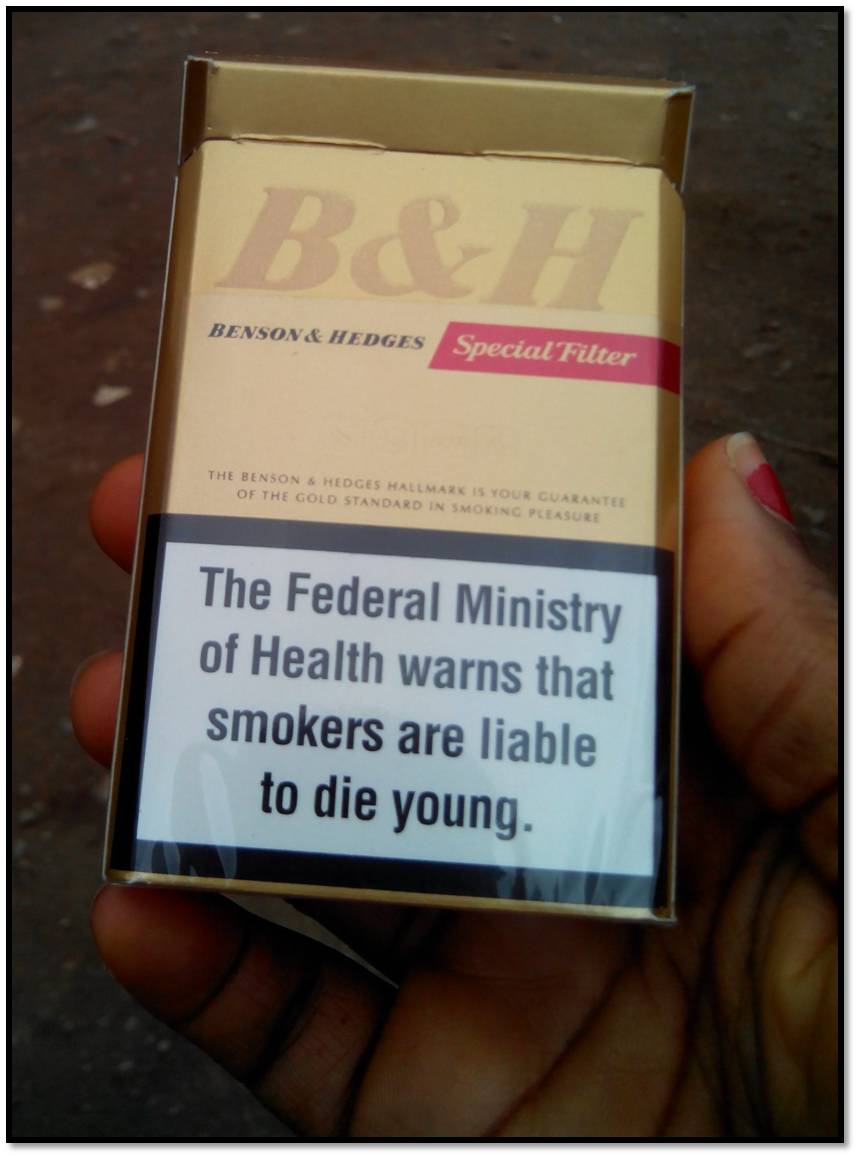
 Have you tried holding a pack of Benson and Hedges in your hands? I still remember visiting the mallam’s kiosk to inquire about the price of cigarettes and I was able to get an empty pack from him. Holding the pack almost made me feel like I had just won a trophy. The pack is plated in gold and the edges are perfectly folded. When you lift the partially detachable lid along the slant divide by the sides, the word that best describes what you sight is - Flawless.

I can say that what I held in my hand was designed to be comely and attractive. An addictive product packaged attractively and with comeliness will win the heart and mind of its users and effortlessly record new converts. Without a doubt, no responsible and concerned Nigerian citizen would want to have a product proven to be the world’s leading cause of preventable death to be so gracefully packaged and presented to the general public but sadly, that is what is currently obtained in our country.

Nigeria had actually made some major attempts at regulating the tobacco industry in order to discourage the deadly act of smoking. The most notable one was in 1990 when the TobaccoSmoking (Control) Act was enacted and it is as a result of this law that cigarette packets now bear the amount of tar and nicotine contained in them. The law also got us familiar with these sentences-  
  •  “The Federal Ministry of health warns that tobacco smoking is dangerous to your health”
  • “Smokers are liable to die young”

The Advertising Practitioners Council of Nigeria (APCON) went a step further in August 2011 when it banned the advertising or promotion of tobacco products on television and restricted advertisement in print, billboards and on radio. Although the move was opposed in some quarters which led the council to extend the deadline for enforcing the ban from January 1, 2001 to January 1, 2004, the ban is largely in effect across the country today. I guess the APCON ban explains why the jingle "Siga Target o, na wa, siga target o na super" ceased on radio and why Golden Tones concerts have long stopped paying the bills in Nigeria’s showbiz industry.

It will interest you to know that the African continent has been recording increase in smoking rate (4.7% annually) while other parts of the world such as North America and Western Europe are seeing notable decrease in smoking prevalence. This shows we need to institute stronger measures that will produce the much desired results of 0% increase in new adopters and decline in number of people who smoke. 

We believe these desires and even more can be met through enactment and enforcement of the new proposed National Tobacco Control Bill that requires among other provisions that all cigarette packs bear clear health warning messages and/or labels covering 50% of the pack’s display area (The health warning on packs at present only coversapproximately 30% of the front and 40% of the back). In addition, the new law will also empower the Minister of Health to prescribe that these warnings should be in form of pictures or pictograms.

Based on this, cigarette packs might be looking like any of the pictures below.

 Now, how many people do you think you will be enticed into buying this product with their money?

You can join our campaign to ensure a smoke-free Nigeria by signing up as a Tobacco Control Cause Champion. Simply send your 1) Name, 2) Email address, 3) Telephone No and 4) Location to info(at)socialresponsibilitymanagers.org. Signing up will get you a chance to have a specially designed Facebook, Twitter and G+ profile banner graced with Stella Damasus' picture.
You should also actively participate in the discussions presently ongoing on the following social media platforms:
- Twitter: Follow @TobaccoCtrl
- Facebook: Visit and like Tobaccoctrl
- Google Plus: add Tobaccoctrl to your circle
- 2go: add Tobaccoctrl